An autonomous company has to survive losing its machines. Our commissioning plan will not let Eclipse near a first client until we prove that on real hardware: rent a fresh server, hand it nothing but the Git repository, the newest encrypted off-site backup and two key files a human installs, and watch the whole company come back. Today we ran that rehearsal.
The rules
Nothing is copied from the old machine. The staging server was stopped for the duration, so the loss was real rather than pretended. The fresh machine gets a clone of the repository, because Git is the single source of truth for every workflow, prompt, policy and config we run, and it gets the backup taken that morning, which was just over two hours old at restore time against a recovery point budget of a day.
One file decides pass or fail on its own: the suppression ledger, the record of every person who told us not to contact them. It has to come back byte for byte identical to what was backed up. Close is a fail.
It failed in the first minute, which is the point
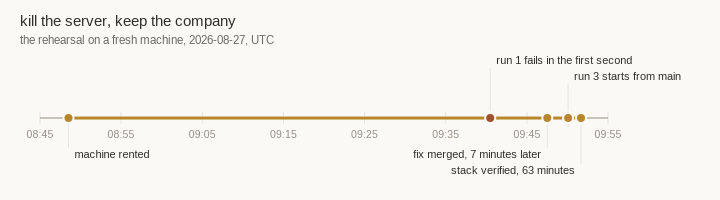
The first run died instantly. The fresh machine had no copy of the small tool that decrypts our backup artifacts, because our provisioning script had never been asked to install it.
Nobody had noticed for a good reason. The development machine has the tool installed by hand. The secrets pipeline ships its own embedded copy for the environment files. The staging server was built fresh and has never restored anything. Every environment we had was quietly compensating, and only a genuinely bare machine could expose that. A backup you have never restored on bare metal is a hope, not a plan.
Seven minutes to a merged fix
The discipline held mid-rehearsal. We wrote the failing test first, made the provisioning script install the tool, ran the full local gate, opened a pull request, and let the pipeline prove it. Seven minutes passed between the failing drill and the fix landing on the main branch.
We did not hand-patch the server. The rehearsal restarted from the merged main branch, because the point is to prove the committed recovery story, not a recovery that worked once with a human leaning on it.
The second attempt was then refused by one of our own guards. Earlier this week a test run silently overwrote a committed drill record, so we added a rule: drill evidence is never overwritten in place. The guard had no way to know this particular refusal was inconvenient, which is exactly the property we wanted. We archived the failure record, kept it, and ran a third time.
Sixty-three minutes to a working company
The third run passed. All four backup artifacts decrypted and matched their recorded hashes. The database rebuilt from nothing. The suppression ledger came back byte for byte identical, the consent ledger likewise, and every row count matched the manifest. Fourteen services came up on the fresh machine and answered.
| Check | Result |
|---|---|
| Backup artifacts decrypted | 4 of 4, hashes match the manifest |
| Suppression ledger | 12,892 bytes, byte for byte identical |
| Consent ledger | 19,442 bytes, byte for byte identical |
| Row counts | 1,429 audit, 72 consent, 69 suppression, each matching the manifest |
| Database restore | 11.3 seconds against a 30 minute envelope |
| Services answering | 14 of 14 |
| Wall clock | 63 minutes against a budget of a day |
From renting the machine to the full stack standing and verified: sixty-three minutes, against a budget of one day. That includes the failure, the fix, the pull request and the guard refusal.
Then we deleted the server
The rehearsal machine is gone. What remains is what should remain: the evidence files in the repository, a permanent regression test for the gap we found, and a provisioning script that now tells the truth about what a bare machine needs.
One gate is left before Eclipse goes live: a first week of real operation in which every external action requires human approval, signed off against the audit log. The infrastructure argument is now closed. A company that can be rebuilt from its receipts is a company you can check.