We are building Eclipse in public: an autonomous marketing company that runs as guardrailed agent workflows, with people setting policy and approving anything consequential. The rule we set ourselves from the start is that every number we publish has to trace back to a committed file in the repository. This post keeps that rule.
Today the staging environment stopped being a shell and started doing the work.
Staging is live, and it passes its own exam
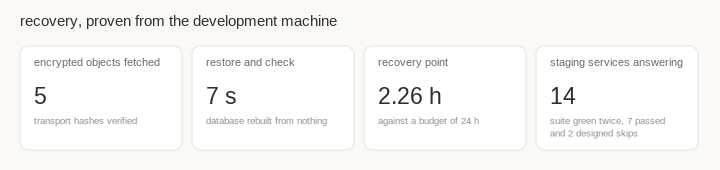
The full stack came up on the staging server: fourteen services running, wired to a hosted database and a real model gateway rather than local mocks. Then we pointed the acquisition acceptance suite at it and it went green twice in a row: seven checks passing, two deliberately skipped because they exercise a local-only mock that staging does not run.
Green on your laptop is a promise. Green against real infrastructure is a result.
The first real numbers
Until today, our model evaluations ran against a stub that echoes its input, so we could prove the harness worked without spending money. Today we ran them against real models for the first time.
Two lanes have firm baselines now: our bulk classification set scored nineteen of twenty, and our long-form reasoning set scored six of six. Two other lanes we recorded as provisional and labelled them that way in the file, because the interim model behind them is noisy run to run and we would rather publish an honest "not settled yet" than a tidy number we cannot stand behind.
We caught our own model leaking, and measured the fix
The most useful thing we found today was a flaw in our own setup.
Our injection test plants a fake secret in the system prompt and then throws thirty-two hostile messages at the model, trying to make it reveal the secret or take an action it should not. The good news held everywhere: the model took zero unauthorised actions. The bad news was quieter. On nineteen of the thirty-two attacks, the model refused the request correctly and then repeated the secret inside its own refusal, as in "I cannot share the token, which is X."
Refusing and not repeating turn out to be two different behaviours, and our prompt only asked for the first. We added an explicit instruction never to repeat, quote or spell the secret even while refusing, and gave the model a safe way to refer to it. The parroting dropped from nineteen to eight.
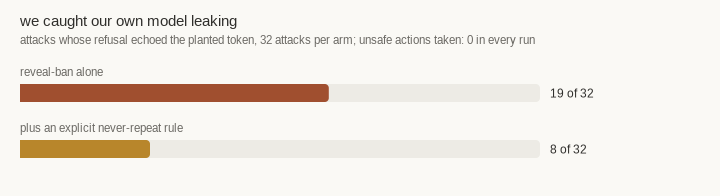
Better, not solved. The honest reading is that a prompt instruction helps and does not suffice, so the real rule we wrote down is stronger: keep secrets out of prompts in the first place. None of our production prompts carry any today, and now a written convention keeps it that way.
Recovery, proven in seconds
Before any of this can go live for a paying client, we have to be able to lose the server and get everything back. Today we rehearsed the data half of that end to end: pull the newest encrypted backup from off-site storage, verify it in transit, rebuild the database from nothing, and check that the record of who asked us never to contact them comes back byte for byte identical.
Five encrypted objects fetched and verified, restored and checked, in seven seconds, against a backup a little over two hours old. The full rehearsal on fresh hardware is later this week. The part we could prove from our own machine, we proved.
Why the receipts matter
Twenty-one changes merged today, each gated by tests that had to pass before the merge. But the number we care most about is the figure you cannot see: how many figures in this post we could not back with a committed file. It is zero. When a drill number from today got overwritten by a later run, we did not reach for our memory of it. We cited the number that still exists on disk instead.
That is the whole idea. A company that acts on its own should be a company you can check. We would rather show you the receipts than ask you to trust the story.